
When working with COBOL on IBM mainframes, understanding how numeric data is stored internally is essential. One of the most common numeric formats is Zoned Decimal in COBOL, which is used to represent numeric values in a human-readable format while maintaining compatibility with the EBCDIC character set.
In this article, we’ll explore how Zoned Decimal in COBOL works, how numbers are stored in EBCDIC format, and how signed and unsigned values are represented internally on mainframe systems.
EBCDIC and ASCII Character Encoding
The two most common character encoding schemes used in computing are ASCII and EBCDIC. While most modern distributed systems use ASCII, IBM mainframes use the Extended Binary Coded Decimal Interchange Code (EBCDIC).
In EBCDIC, each byte consists of eight bits and is divided into two parts:
- Zone Portion (first 4 bits)
- Digit Portion (last 4 bits)
Each group of four bits corresponds to a hexadecimal digit. When HEX mode is enabled in ISPF, you can view the hexadecimal representation of characters and numeric values directly alongside the data.
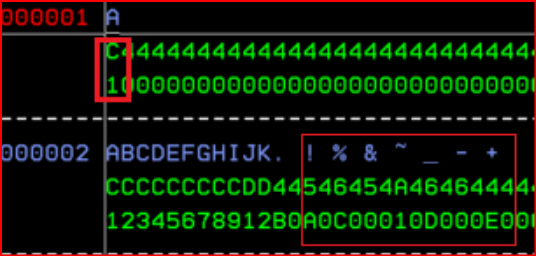
The following table shows the EBCDIC table in mainframe. (Source: google). Char A has HEX C1.

With HEX mode is turned on in ISPF, the same information can be seen against the characters and the special characters which we type. Thus we can see A=C1 below.
How Zoned Decimal in COBOL Works
In zoned decimal field stores one numeric digit in each byte of storage.
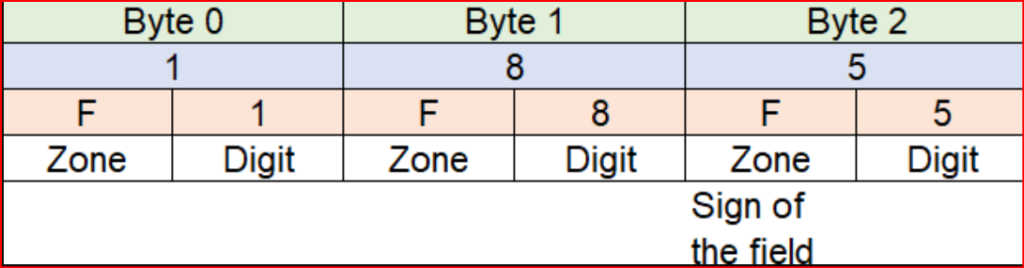
Consider the number 185. Internally, the digits are stored as: F1 F8 F5
Unsigned Zoned Decimal Fields
For unsigned, zoned-decimal fields are considered positive. Thus 185(=F1 F8 F5) will be stored as shown below. In this case, the value is treated as positive number.
Signed Zoned Decimal Fields
For signed fields, the sign is stored in the zone portion of the rightmost byte. The zone portions of all preceding bytes are ignored for sign purposes.COBOL uses the following conventions:
COBOL uses the following conventions.
X’Cn’ = Positive sign
X’Dn’ = Negative sign
Thus, a negative value of -185 would be stored as:F1 F8 D5
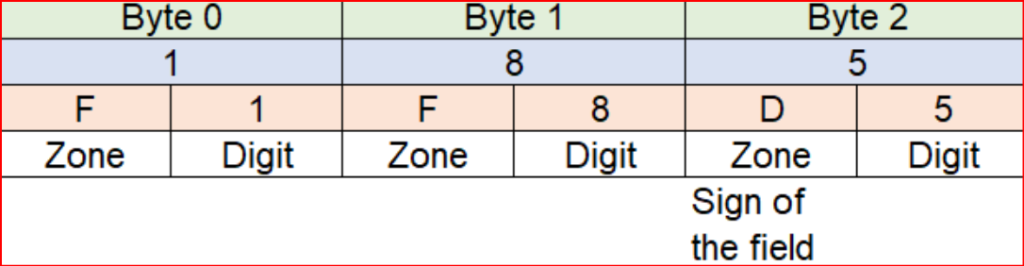
Similarly, positive value of 185 may be stored as:F1 F8 C5
Conclusion
Zoned Decimal in COBOL is a numeric storage format widely used on IBM mainframes. By understanding how EBCDIC encoding works and how signed and unsigned values are represented, developers can more effectively troubleshoot data issues, interpret file contents, and work with COBOL applications. Mastering Zoned Decimal in COBOL is a fundamental skill for anyone involved in mainframe development or production support.