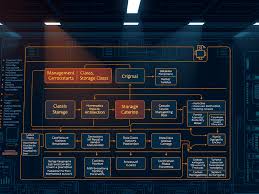
Understanding SMS Parameters in z/OS is essential for every mainframe professional. The Storage Management Subsystem (SMS) simplifies dataset allocation and management by automatically assigning storage-related attributes. Instead of manually coding dataset parameters in JCL, SMS uses predefined rules to ensure consistency, efficiency, and standardization across the z/OS environment.
What Are SMS Parameters in z/OS?
SMS Parameters in z/OS are configuration settings that control how datasets are created, stored, managed, and maintained. SMS automatically assigns these parameters during dataset allocation, reducing the need for programmers to specify values manually in JCL.
The main SMS components are:
- Management Class (MGMTCLAS)
- Storage Class (STORCLAS)
- Data Class (DATACLAS)
- Storage Group (STORGRP)
These components work together to manage datasets efficiently.
🔍 Quick Look: Key SMS Classes

1. Management Class (MGMTCLAS)
As the name suggests, Management Class controls the lifecycle of a dataset.
Key responsibilities include:
- Migrating inactive datasets to archival storage
- Automatically deleting datasets after the retention period expires
- Releasing unused space within allocated datasets
👉 This ensures optimal storage usage without manual intervention.
2. Storage Class (STORCLAS)
The Storage Class determines where and how your dataset is physically stored.
It defines:
- Volume Serial (VOLSER) — where the dataset resides
- Device Type — type of storage hardware used
👉 This abstraction allows your JCL to stay clean while SMS decides the best storage location.
3. Data Class (DATACLAS)
The Data Class defines dataset characteristics, eliminating the need to code them manually in JCL.
It includes:
- Record Organization (RECORG)
- Record Format (RECFM)
- Logical Record Length (LRECL)
For VSAM datasets, it can also define:
- IMBED / REPLICATE
- CISIZE
- FREESPACE
- SHAREOPTIONS
✅ Big advantage: Programmers don’t have to specify these in DD statements, resulting in cleaner and standardized JCL.
⚠️ Important: Values from DATACLAS can still be overridden if explicitly coded in the JCL.
How SMS Simplifies JCL
Without SMS, programmers often need to code dataset attributes directly in JCL.
Example:
//DD1 DD DSN=PAYROLL.PROD.MASTER,
//       DISP=(NEW,CATLG),
//       UNIT=3390,
//       SPACE=(CYL,(10,5)),
//       RECFM=FB,
//       LRECL=80
With SMS, the JCL becomes much simpler:
//DD1 DD DSN=PAYROLL.PROD.MASTER,
//       DISP=(NEW,CATLG)
ACS Routines in z/OS
The assignment of SMS Parameters in z/OS is controlled by ACS (Automatic Class Selection) routines.
ACS routines evaluate information such as:
- Dataset name
- High-Level Qualifier (HLQ)
- User ID
- Application type
- Allocation request details
Based on these conditions, ACS routines automatically assign:
- Data Class
- Storage Class
- Management Class
- Storage Group
Benefits of SMS Parameters in z/OS
Using SMS Parameters in z/OS provides several advantages:
- Reduced JCL complexity
- Consistent dataset definitions
- Automated storage management
- Improved storage utilization
- Easier administration
- Better compliance with enterprise standards
These benefits make SMS an essential component of modern z/OS environments.