Imagine an application that processes thousands of log files every night. The results are important, but they are not urgent. If a job fails today, it can simply run again tomorrow.
This is where Preemptible VM vs Spot VM becomes an important decision. When running workloads in Google Cloud, not every application needs always-on infrastructure. Some workloads only need low-cost compute power, even if there is a chance they may be interrupted.
Let’s understand the difference through a simple story.
The Story: Two Teams, One Goal
Two teams want to reduce their cloud costs without sacrificing performance.
Team A runs nightly batch jobs that finish within a few hours. If a job fails, they can retry it the next day.
Team B trains machine learning models that may run for days. However, they still want the lowest possible compute costs.
As a result:
- Team A chooses Preemptible VMs
- Team B chooses Spot VMs
Why did they make different choices? Let’s explore.
What Are Preemptible VMs?
Preemptible VMs are low-cost virtual machines in Google Cloud that can be up to 80% cheaper than regular on-demand instances.
However, there is an important limitation.
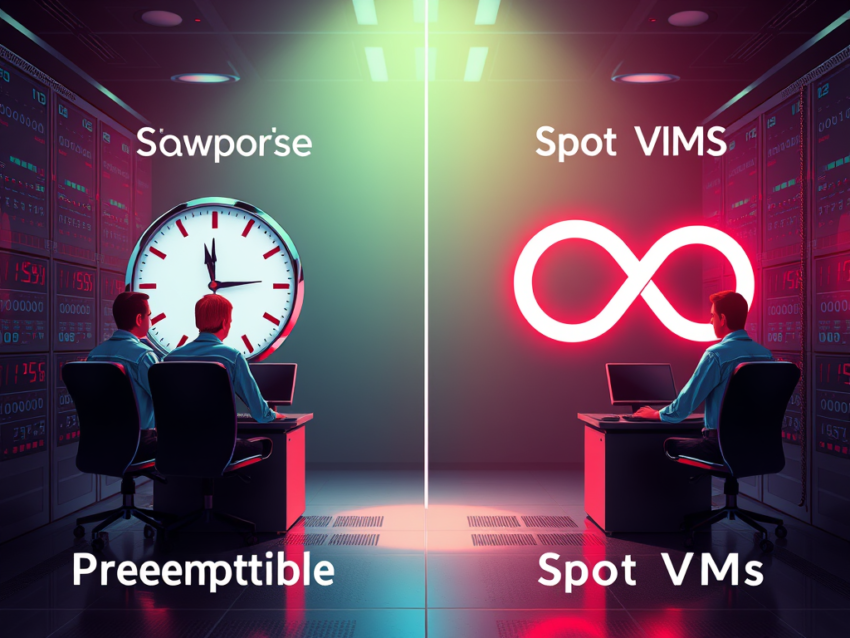
A Preemptible VM will always stop within 24 hours, even if Google Cloud has available capacity. In addition, Google Cloud can terminate the instance earlier if resources are needed elsewhere.
Before termination, Google Cloud provides a 30-second warning, allowing applications to save their progress.
Best Use Cases for Preemptible VMs
Preemptible VMs are ideal for:
- Batch processing jobs
- Data analytics workloads
- Video rendering
- Fault-tolerant applications
- Short-running compute tasks
If your workload can restart easily and finish within a day, a Preemptible VM is often the most economical option.
What Are Spot VMs?
Spot VMs are the modern replacement for Preemptible VMs in Google Cloud.
Like Preemptible VMs, Spot VMs are significantly cheaper than standard virtual machines. They can also be interrupted at any time when Google Cloud requires the capacity.
The major difference is that Spot VMs do not have a fixed 24-hour runtime limit.
As long as resources remain available, a Spot VM can continue running for days or even weeks.
Just like Preemptible VMs, Google Cloud provides a 30-second warning before termination.
Best Use Cases for Spot VMs
Spot VMs work well for:
- AI and machine learning training
- Long-running analytics workloads
- Scientific simulations
- Distributed computing jobs
- Large-scale data processing
Therefore, Spot VMs are often the better choice when workloads need more time to complete.
Preemptible VM vs Spot VM: Key Differences
| Feature | Preemptible VM | Spot VM |
|---|---|---|
| Maximum Runtime | 24-hour limit | No runtime limit |
| Can Be Interrupted | Yes | Yes |
| Preemption Notice | 30 seconds | 30 seconds |
| Pricing | Up to 80% cheaper | 60–91% cheaper |
| SLA | No | No |
| Auto Restart | No | No |
| Best For | Short batch jobs | Long-running workloads |
Preemptible VM vs Spot VM: Which Should You Choose?
Choosing between a Preemptible VM vs Spot VM depends on your workload requirements.
Use a Preemptible VM when:
- Jobs finish within 24 hours
- Workloads can be restarted easily
- Cost savings are the highest priority
Use a Spot VM when:
- Workloads run for multiple days
- Long-running compute tasks are required
- You want low costs without a fixed runtime limit
Final Thoughts on Preemptible VM vs Spot VM
Understanding the difference between a Preemptible VM vs Spot VM can help you significantly reduce cloud costs.
A Preemptible VM is designed for short-lived, fault-tolerant workloads and comes with a strict 24-hour limit.
A Spot VM offers the same low-cost benefits but removes the runtime restriction, making it ideal for long-running workloads.
In short:
✔ Use Preemptible VMs for short batch jobs.
✔ Use Spot VMs for long-running, cost-effective compute workloads.
By choosing the right option, you can maximize performance while keeping your Google Cloud bill under control.