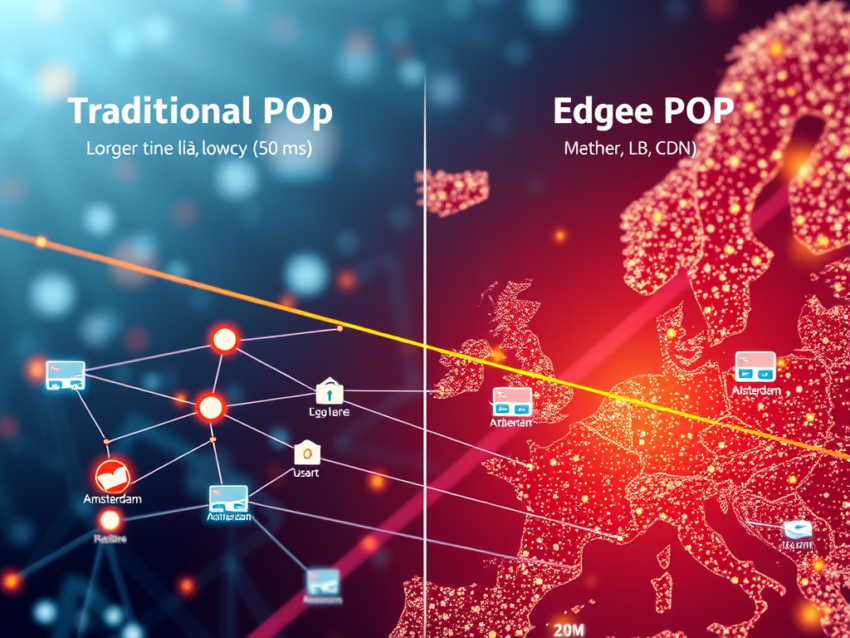
POP vs Edge POP is a common networking topic for organizations using Google Cloud. While both POPs (Points of Presence) and Edge POPs help route traffic between users and cloud services, they serve different purposes.
A POP acts as an intermediate routing point between a GCP region and end users, whereas an Edge POP is a nearby entry point where user traffic is terminated, accelerated, and carried over Google’s private backbone.
Understanding the difference between a POP and an Edge POP is essential for optimizing application performance and reducing latency.
Difference in Real‑World Latency (One Example)
Example:
A user in Amsterdam accessing an application hosted in GCP europe‑west4 (Netherlands).
Without an Edge POP (Regular POP / Direct to Region)
User
  |
  |  Public Internet (ISP hops, IXPs) ~40 ms
  |
POP (routing only)
  |
  |  Google network ~10 ms
  v
GCP Region
Result
- Traffic stays on the public internet longer.
- POP only routes traffic; no acceleration.
- Typical latency: ~50 ms
With an Edge POP (Ingress + Acceleration)
User
  |
  |  Short ISP hop ~5 ms
  v
Edge POP (Amsterdam)
  |  - Connection terminates
  |  - TLS / LB / CDN
  |
  |  Google private backbone ~5 ms
  v
GCP Region
Result
- User enters Google’s network almost immediately
- Traffic rides Google’s private backbone
- Typical latency: ~10 ms
One‑Line Takeaway
A POP is a mid‑network routing point, while an Edge POP is a nearby entry point where user traffic is terminated and accelerated—cutting real‑world latency from ~50 ms to ~10 ms.