What Happens When Millions of Users Click “Buy Now” at the Same Time?
Imagine you’re running a successful e-commerce platform during a flash sale. Thousands of customers browse products, add items to their carts, place orders, track deliveries, and generate millions of clicks every minute. Can a single database handle all these workloads efficiently? Not really.
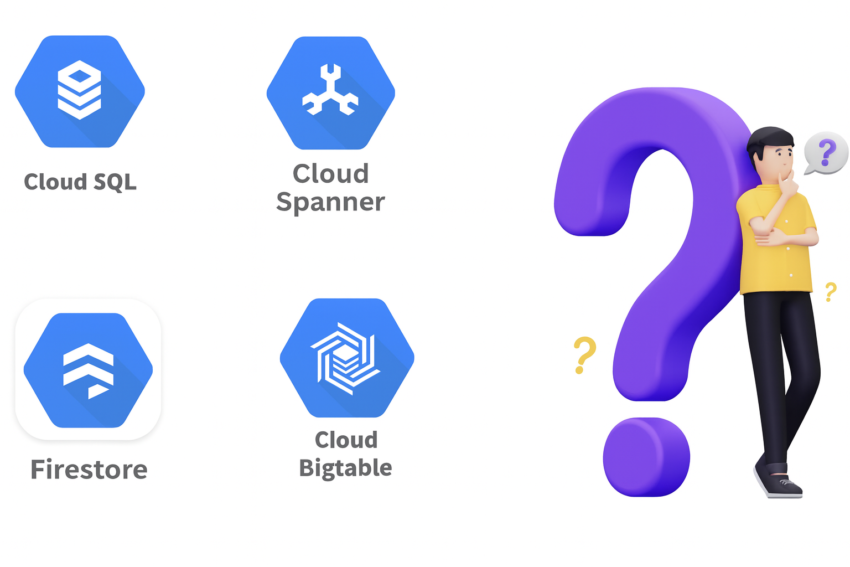
This GCP database comparison explains when to use Cloud SQL, Cloud Spanner, Firestore, and Bigtable by following the journey of a growing e-commerce application.
Different parts of an application have different requirements. Some need strong transactional consistency, others need real-time updates, and some must process massive amounts of data at lightning speed.
🧾 Managing Core Business Operations with Cloud SQL
Every e-commerce platform starts with structured transactional data:
- Customer accounts
- Product catalogs
- Orders
- Payments
These workloads require strong consistency and reliable transactions.
Why Cloud SQL?
Cloud SQL is ideal for applications that need:
- Relational schemas
- SQL queries
- ACID transactions
- Strong consistency
Because orders and payments cannot tolerate inconsistencies, Cloud SQL serves as the foundation for the platform’s core business operations.
⚡ Delivering a Real-Time Shopping Experience with Firestore
Once the platform can reliably process transactions, the next challenge is creating a responsive user experience.
Customers expect instant updates when they:
- Add products to their cart
- Track order status
- Receive notifications
- Interact with customer support
Why Firestore?
Firestore provides:
- Real-time data synchronization
- Automatic scaling
- Flexible document-based storage
- Minimal operational overhead
As a result, users see updates immediately across devices without the application team managing database infrastructure.
📊 Understanding User Behavior with Bigtable
As traffic grows, the business wants to understand how customers interact with the platform.
Every click generates valuable data:
- Product views
- Search activity
- Clickstream events
- Recommendation signals
The volume quickly grows from thousands to millions of events.
Why Bigtable?
Bigtable excels at:
- High-throughput workloads
- Low-latency access
- Time-series data
- Event logging and analytics
Because it can process massive amounts of data efficiently, Bigtable becomes the ideal choice for analytics, monitoring, recommendation engines, and behavioral insights.
🌍 Scaling Globally with Cloud Spanner
Success brings a new challenge: global expansion.
Now customers place orders from different countries and continents.
The platform must:
- Keep data consistent worldwide
- Support global transactions
- Maintain low latency
- Scale horizontally
Why Cloud Spanner?
Cloud Spanner combines:
- Relational database capabilities
- SQL support
- Horizontal scalability
- Global consistency
Unlike traditional relational databases, Spanner allows organizations to scale globally without sacrificing transactional integrity.
This makes it a strong choice for financial systems, payment platforms, and mission-critical global applications.
🧩 The Complete Picture
A successful e-commerce platform rarely relies on a single database.
Instead, each database serves a specific purpose:
- Cloud SQL stores customer records, orders, and payment transactions.
- Firestore powers shopping carts, notifications, and other real-time interactions.
- Bigtable captures clickstream data and large-scale analytics.
- Cloud Spanner supports globally distributed transactions with strong consistency.
Together, these databases create a scalable, reliable, and high-performance architecture.
GCP Database Comparison Summary
| Product | Recommended Use Cases |
|---|---|
| Cloud SQL | Relational applications, transactional workloads, business systems, and SQL-based applications |
| Cloud Spanner | Global-scale applications, financial systems, distributed transactions, and highly consistent workloads |
| Firestore | Real-time applications, mobile and web backends, shopping carts, chat applications, and flexible schemas |
| Bigtable | Analytics, IoT, time-series data, clickstream logs, recommendation systems, and machine learning datasets |
Conclusion: Choosing the Right GCP Database
This GCP database comparison shows that no single database fits every workload.
Instead, Google Cloud provides specialized databases designed for specific requirements:
- Use Cloud SQL for transactional and relational workloads.
- Use Firestore for real-time user experiences.
- Use Bigtable for large-scale analytics and time-series data.
- Use Cloud Spanner for globally distributed applications that require strong consistency.
The key lesson is simple:
Don’t choose a database based on popularity—choose it based on the workload.
When millions of shoppers click “Buy Now” at the same time, it’s not magic that keeps everything running smoothly.
It’s the architecture.