Google Anthos: Managing Kubernetes Across Hybrid and Multi-Cloud Environments
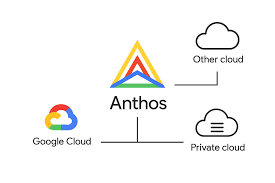
Google Anthos is a hybrid and multi-cloud platform that helps organizations manage Kubernetes clusters across Google Cloud, on-premises data centers, and other cloud providers. It provides a consistent way to deploy, secure, and operate applications across different environments using a unified set of tools.
Today, many enterprises run workloads in multiple locations. Some applications run in the cloud, while others remain on-premises due to business, security, or compliance requirements. As infrastructure becomes more distributed, managing Kubernetes clusters separately can create operational challenges. Therefore, many organizations adopt Anthos to simplify management and improve consistency.
Conceptually,

Why Organizations Use Anthos
Without a centralized management platform, administrators must configure and monitor each environment independently. As a result, maintaining security, governance, and operational standards becomes more difficult.
Anthos addresses these challenges by providing a single control plane for Kubernetes management across hybrid and multi-cloud environments.
What Is Google Anthos?
At its core, Google Anthos is a Kubernetes management solution that enables organizations to manage clusters from a central location.
The platform supports:
- Google Cloud Platform (GCP)
- On-premises data centers
- Multi-cloud deployments
Because all environments can be managed through a common interface, teams gain greater visibility and operational control. In addition, administrators can apply consistent policies across every cluster.
Config Management
One of the most valuable capabilities is Anthos Config Management.
This feature allows teams to define configurations and policies once and then apply them automatically across all registered clusters.
Benefits include:
- Consistent security policies
- Standardized cluster configurations
- Reduced manual effort
- Improved compliance
- Better governance
Furthermore, centralized configuration management helps prevent configuration drift, which can occur when environments evolve independently.
Unified Infrastructure Management
The platform provides a centralized view of Kubernetes clusters regardless of where they are deployed.
Instead of switching between multiple tools and dashboards, administrators can manage infrastructure from a single interface. Consequently, operational tasks become easier and more efficient.
Key advantages include:
- Better visibility
- Simplified administration
- Faster troubleshooting
- Consistent operations
- Improved resource management
This approach enables platform teams to scale Kubernetes environments more effectively.
Service Mesh Capabilities
Anthos includes a service mesh solution based on Istio.
A service mesh helps manage communication between microservices while improving security and observability. In addition, it provides advanced traffic management capabilities for distributed applications.
Organizations can use these capabilities to:
- Secure service-to-service communication
- Monitor application performance
- Control traffic routing
- Improve reliability
- Gain deeper operational insights
As a result, teams can operate complex microservices architectures with greater confidence.
Registering Kubernetes Clusters
After enabling the service, administrators can register Kubernetes clusters through the Google Cloud Console, APIs, or command-line tools.
Once a cluster is registered, it becomes visible within the centralized management environment. This makes it easier to monitor workloads, enforce policies, and maintain operational consistency across multiple locations.
Whether clusters run in Google Cloud, on-premises, or another cloud provider, they can be managed using the same set of tools.
Common Use Cases
Many enterprises use Anthos to support modern cloud strategies.
Common use cases include:
- Hybrid cloud deployments
- Multi-cloud operations
- Application modernization projects
- Kubernetes governance initiatives
- Regulatory compliance requirements
- Centralized infrastructure management
These capabilities make the platform particularly attractive for large organizations with distributed environments.
Conclusion
Google Anthos provides a unified approach to managing Kubernetes clusters across cloud and on-premises environments. By combining centralized management, policy enforcement, and service mesh capabilities, the platform helps organizations simplify operations while maintaining consistency and security.
For businesses adopting hybrid or multi-cloud architectures, Anthos offers a practical way to manage Kubernetes workloads through a single, integrated platform.