Imagine a fast-growing startup sitting on terabytes of valuable customer data locked inside your on-premises data center. Your leadership team wants real-time dashboards, AI-powered predictions, and deep customer trend analysis using Google BigQuery and machine learning—but there’s a problem:
Your data can’t generate insights if it can’t reach the cloud—securely, reliably, and at scale
How do we connect our existing data center to Google Cloud without compromising security or performance?
That’s where Cloud VPN and Cloud Interconnect enter the picture.
There are two main connectivity solutions you can use depending on your scale, security needs, and performance expectations:
1.🚧 Cloud VPN?
A Cloud VPN is a foundational hybrid network connectivity service that creates secure, encrypted tunnels over the public internet between your on-premises network and your Google Virtual Private Cloud (VPC). It’s like building an encrypted “virtual pipe” that ensures data in transit remains protected using IPsec encryption protocols (IKE/IKEv2) and tunneled traffic.

✅ Benefits of Cloud VPN
- Encrypted connectivity over public internet — secure data transport.
- Quick to set up for initial connectivity or pilot analytics workloads.
- Works with BigQuery, Compute Engine, Cloud SQL, and other cloud services.
🚨 Limitations
- Performance depends on public internet quality, so bandwidth and latency can vary.
Continuing with the example, as business scales, the need for higher performance, more reliability, and lower latency increases which a standard internet VPN cannot provide. That’s where Google Cloud Interconnect comes in, offering dedicated, high-availability network links between your infrastructure and Google Cloud — bypassing the public internet entirely.
2.🌐 Cloud Interconnect?
Cloud Interconnect lets you extend your on-premises network into Google’s backbone through dedicated physical connections. This means faster, more predictable network performance — perfect for large data transfers, real-time analytics, or enterprise-grade hybrid architectures.
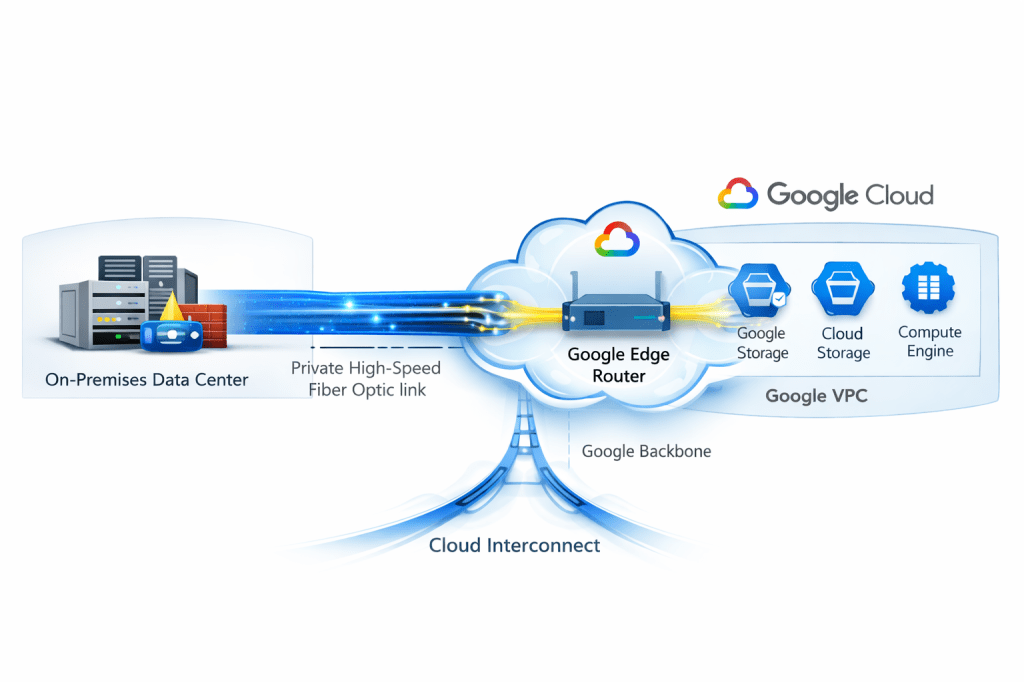
🧠 Cloud Interconnect Types
- Dedicated Interconnect
- Connects your on-premises router directly to a Google edge router over a private link.
- Offers high throughput (10–100 Gbps) and low latency.
- Great for premium hybrid cloud deployments.
- Partner Interconnect
- Connectivity through a Google-approved network partner if you’re not near a Google Interconnect location.
- Ideal when direct physical access to a Google facility is not available.
So let’s have the comparison table
| Feature | Cloud VPN | Cloud Interconnect |
|---|---|---|
| Security | Encrypted (IPsec) over internet | Can be private; optional encryption layers |
| Performance | Depends on internet | High-bandwidth, low latency |
| Use Case | Initial testing, small workloads | Enterprise analytics, real-time systems |
| Scalability | Limited by internet | Scales with dedicated links |
| Cost | Lower | Higher (but more predictable performance) |
🔍 Final Takeaways
- Cloud VPN provides secure, encrypted entry into Google Cloud — ideal for startups and early cloud adoption.
- Cloud Interconnect delivers dedicated network connectivity that scales with your business — essential for high-performance hybrid cloud analytics.
- Choose based on network performance needs, security requirements, and long-term hybrid architecture strategy
 DBzTech-Technology Dossier
Leave a comment