Artificial Intelligence (AI) is no longer just a futuristic concept—it’s shaping the way we work, communicate, and live. At its core, AI is the field of computer science focused on creating systems that can perform tasks traditionally requiring human intelligence.
Think of speech recognition, language translation, or pattern identification—all these are powered by AI.
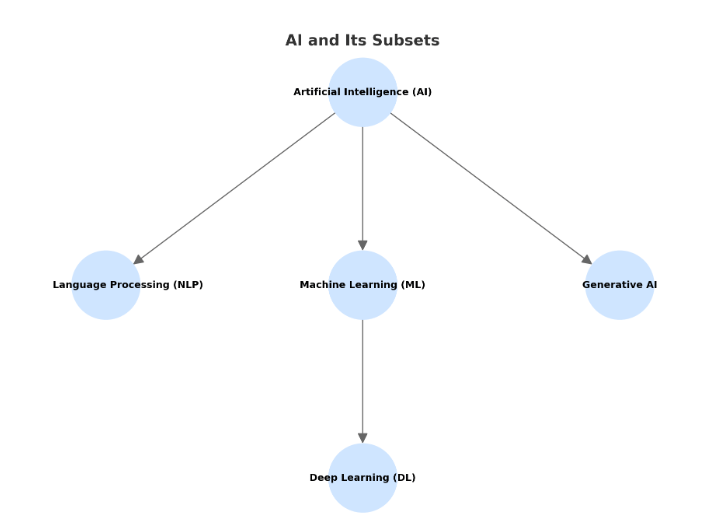
AI is an umbrella term covering many specialized fields, including:
- Machine Learning (ML)
- Deep Learning (DL)
- Computer Vision
- Natural Language Processing (NLP)
- Generative AI
Here’s a high-level look at some of these key areas.
1. Natural Language Processing (NLP)
NLP focuses on enabling computers to understand, interpret, and respond to human language—both spoken and written. The goal is to bridge the communication gap between humans and machines.
💡 Example: A customer service chatbot powered by NLP can answer common product questions instantly, freeing up human agents to handle more complex issues.
Key uses of NLP:
Text summarization
Sentiment analysis
Voice assistants
Language translation
2. Generative AI
Generative AI (GenAI) is a type of AI that creates—it can produce text, images, audio, or even synthetic data. The process starts with a prompt, which could be text, an image, a video snippet, a piece of music, or any other input the AI can process. In response, the AI generates new content. This introduces two new terms to us:
- Prompt: The instruction or question you give to the AI.
- LLM (Large Language Model): The brain behind many GenAI applications, trained on massive datasets.
Two important terms in GenAI:
Closed-source examples: GPT-3 / GPT-4 (OpenAI)
Open-source examples: LLaMA (Meta)
3. Machine Learning (ML)
Machine Learning is an approach within AI that enables systems to learn from data without being explicitly programmed. ML algorithms analyze large datasets—photos, messages, documents, user behavior—and use patterns in this data to make predictions or decisions.
Key points:
- ML adapts and improves over time with experience.
- The more quality data the model has, the better it can perform.
4. Deep Learning (DL)
Deep Learning is a subset of ML that uses artificial neural networks to handle more complex patterns and achieve higher accuracy. These neural networks are inspired by the way the human brain processes information.
Advantages of DL:
- Handles massive datasets
- Excels in tasks like image recognition, speech synthesis, and autonomous driving
Real-World Impact
AI powers everyday technologies—from spam filters in your inbox to recommendation systems on streaming platforms, from medical image analysis to self-driving cars. And we’re only seeing the tip of the iceberg.
Conclusion
AI is a vast and evolving field. Understanding its main branches—NLP, Generative AI, ML, and DL—gives us a clearer picture of how machines are becoming more intelligent and capable. In future posts, we’ll dive deeper into topics like Large Language Models, AI ethics, and emerging applications.
 DBzTech-Technology Dossier
Leave a comment