Running SAS on a mainframe environment like z/OS allows you to process massive enterprise datasets with high performance. Among the most commonly used SAS procedures are PROC SORT, which help you sort, filter, join and organize your data efficiently.
What is PROC SORT in SAS on Mainframe?
PROC SORT is one of the most frequently used procedures in SAS on z/OS. It allows to:
1. Sort large mainframe datasets
2. Apply filtering before sorting
3. Remove duplicates using NODUP or NODUPKEY
4. Prepare data for reporting or further analysis
Basic PROC SORT Example
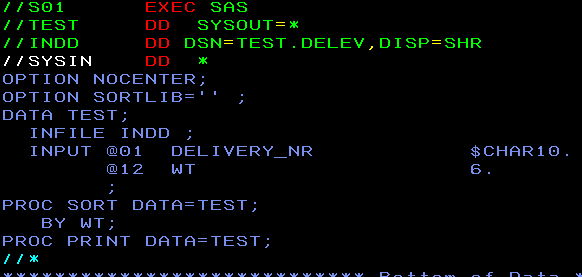
The output will be sorted according to the weights. The Default is Ascending.

To use Descending, the syntax will be

Filtering Data Before Sorting
If the data needs to be filtered before sorting, then WHERE Option can be used in PROC SORT statement. PROC SORT DATA=TEST (WHERE=(DELIVERY_NR='XXXXXXXXXX')) ;
BY WT;
Removing Duplicates
NODUPKEY option is used to remove duplicates based on the variable(s) specified in BY statement.PROC SORT DATA=TEST NODUPKEY;
BY WT;
NODUP can be used when all the duplicates need to be removed based on values of all variables in the dataset.
Important PROC SORT Options
| Option | Purpose |
|---|---|
BY | Variables to sort on |
DESCENDING | Sort in reverse order |
WHERE= | Filter before sort |
NODUPKEY | Remove duplicates based on BY variables |
NODUP | Remove duplicates based on entire row |
 DBzTech-Technology Dossier
Leave a comment